World Map › Guides
Guide
Where Can You See the Northern Lights? The Best Places on Earth
Published · Live Atlas
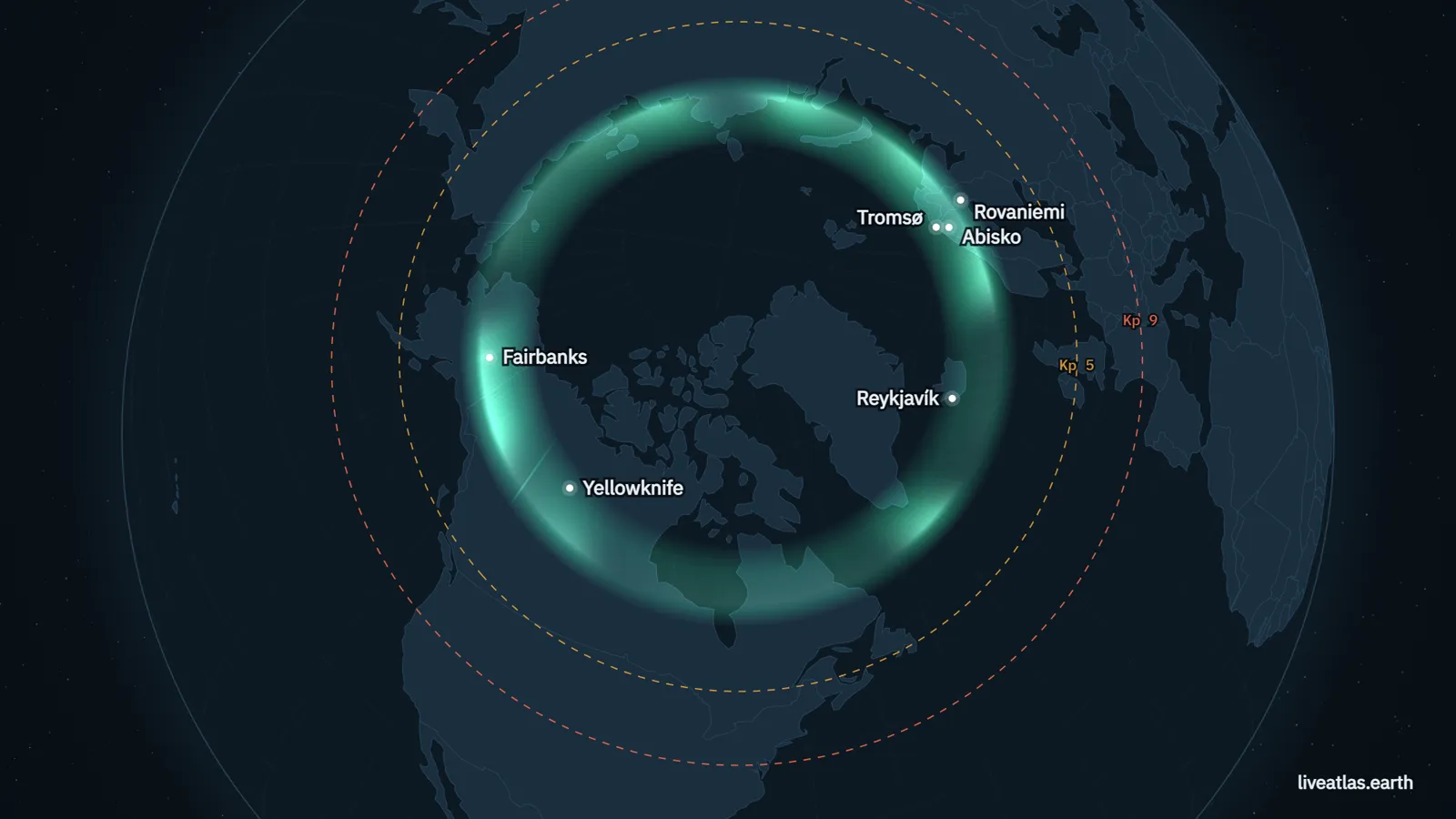
The northern lights shine most often under the auroral oval, a ring around the north magnetic pole that NOAA places roughly between 60 and 75 degrees of latitude. The best places sit right under it, like Fairbanks in Alaska, Yellowknife in Canada, Iceland, Tromsø in Norway, Abisko in Sweden and Finnish Lapland. Go between September and March, and watch from about 10 p.m. to 2 a.m.
Loading the latest NOAA data…
The higher the Kp, the farther south the oval reaches. Full forecast on our Northern Lights Tonight page.
The Ring Where the Aurora Lives
The aurora does not spread evenly over the far north. It glows in a ring centered on the magnetic pole, which sits in the islands of northeastern Canada, not at the North Pole itself. Under that ring, NOAA says the aurora can be seen on more than half of all nights. A mirror ring circles the south magnetic pole and makes the southern lights.
In a geomagnetic storm, the ring grows and slides toward the Equator. That is how the aurora sometimes reaches the northern United States, Europe and Asia. One catch applies everywhere near the poles. In summer the sky never gets dark enough, so the aurora is there but you cannot see it.
The Best Places to See the Northern Lights
| Place | Latitude | Magnetic latitude | Season |
|---|---|---|---|
| Fairbanks, Alaska | 64.8° N | 65.7° | About Aug 21 to Apr 21 |
| Yellowknife, Canada | 62.5° N | 68.5° | Mid-August to mid-April |
| Reykjavík, Iceland | 64.1° N | 68.8° | September to April |
| Tromsø, Norway | 69.6° N | 67.5° | Late August to late March |
| Abisko, Sweden | 68.4° N | 66.3° | October to late March |
| Rovaniemi, Finland | 66.5° N | 63.6° | Late August to early April |
Seasons as given by the University of Alaska Fairbanks and the official tourism boards of Canada, Iceland, Norway, Swedish Lapland and Finland. Magnetic latitude measures how close a place is to the magnetic pole. We computed it with a simple model of Earth's magnetic field, so it is a close approximation.
Fairbanks, Alaska
The University of Alaska Fairbanks puts its city among the places with a good chance of seeing the aurora right overhead on a night of average activity. The season runs from about August 21 to April 21, best around the equinoxes in March and September. The university's tip is to stay at least three nights, which gives a strong chance of a show if the skies are clear.
Yellowknife, Canada
Destination Canada says Yellowknife sits directly beneath the auroral oval and averages 240 nights of aurora a year. There are two seasons, mid-August to late September, then mid-November to early April.
Iceland
Visit Iceland gives September to April as the season, with the equinox months of September and March often the liveliest. The whole country sits near the oval. The main thing is to leave the lights of Reykjavík behind.
Tromsø, Norway
Visit Norway calls Tromsø the main hub for northern lights trips, with direct international flights. Northern Norway is dark from afternoon to late morning in winter, the season runs from late August to late March, and the peak time is often 11 p.m. to 2 a.m. Spring and autumn bring the most activity.
Abisko, Sweden
About 100 km northwest of Kiruna, Abisko gets less rain than the rest of Sweden, so it often keeps a patch of clear sky when clouds cover everything around it. The Aurora Sky Station sits 900 meters up Mount Njullá, reached by a chairlift of about 20 minutes.
Finnish Lapland
The Finnish Meteorological Institute counts aurora on three clear nights out of four in northern Lapland, and one in two around Sodankylä. In Helsinki it falls to about one night a month. Visit Finland puts the season from late August to early April, and Rovaniemi, on the Arctic Circle, is the usual gateway.
Why Canada Beats Norway at the Same Latitude
Because the ring is centered on the magnetic pole in northern Canada, it tilts. It runs far south over North America and high over Europe, as the map at the top of this page shows. Yellowknife, at 62.5° N, is magnetically closer to the pole than Tromsø, which lies 7 degrees farther north on the map.
The same tilt helps the United States. Chicago sits at the same magnetic latitude as Paris, even though Paris is about 7 degrees farther north. Minneapolis lines up with London, and New York with Paris. That is why the same storm that reaches Paris can also light up Chicago, much closer to the Equator.
How Far South Can a Storm Push It?
NOAA's rule of thumb is that the southern edge of the oval sits near 66° magnetic latitude when the sky is quiet (Kp 0), and moves about 2 degrees closer to the Equator with each step of the Kp index. The dashed rings on the map at the top of this page show that edge at Kp 5 and Kp 9. Here is roughly the Kp it takes to bring the aurora overhead.
| City | Latitude | Magnetic latitude | Kp for the aurora overhead |
|---|---|---|---|
| Anchorage | 61.2° N | 61.9° | about 2 |
| Edmonton | 53.5° N | 60.0° | about 3 |
| Oslo | 59.9° N | 59.7° | about 3 |
| Edinburgh | 56.0° N | 58.1° | about 4 |
| Minneapolis | 45.0° N | 53.5° | about 6 |
| London | 51.5° N | 53.3° | about 6 |
| Seattle | 47.6° N | 53.0° | 6 to 7 |
| Chicago | 41.9° N | 50.7° | about 8 |
| Paris | 48.9° N | 50.4° | about 8 |
| New York | 40.7° N | 49.9° | about 8 |
A rough guide only. You do not need the aurora overhead to see it. NOAA notes that from a hilltop you can spot it on the northern horizon up to about 1,000 km away, so a glow often shows up at a Kp or two lower than listed.
Where to See the Southern Lights
The southern ring sits mostly over the ocean and Antarctica, so fewer people live under it. Australia's Bureau of Meteorology says the aurora australis is seen most often in Tasmania and along parts of the Victorian coast, usually low over the southern horizon, best from a dark beach or headland.
In New Zealand, Stewart Island (Rakiura), off the far south of the South Island, became an International Dark Sky Sanctuary in 2019, with almost no light pollution. Hobart and Stewart Island both sit near 50° magnetic latitude, about as far from the magnetic pole as Paris.
When to Go
- Months. September to March in the north. NOAA notes that the spring and autumn equinoxes bring more big storms, and the Finnish Meteorological Institute lists February to March and September to October as the best periods.
- Hours. NOAA puts the best window from 10 p.m. to 2 a.m., an hour or two either side of midnight.
- Moon and clouds. A full moon washes out faint aurora, and clouds hide everything. Plan several nights rather than one.
Is Tonight the Night?
Our Northern Lights Tonight page shows the live Kp and the NOAA forecast, and how far south each storm level can reach. To understand what makes the sky glow, read What Causes the Northern Lights?
Sources
- NOAA Space Weather Prediction Center, Aurora
- NOAA SWPC, Tips on Viewing the Aurora
- University of Alaska Fairbanks, Geophysical Institute, Aurora Forecast
- NOAA NCEI, Wandering of the Geomagnetic Poles (geomagnetic north pole 2025, WMM2025)
- Visit Norway, Northern lights
- Swedish Lapland, Abisko, world's best place for the northern lights
- Finnish Meteorological Institute, Northern lights
- Visit Finland, How to see the Northern Lights in Finland
- Visit Iceland, The Northern lights in Iceland
- Destination Canada, The best time to see the aurora in Yellowknife
- Australian Bureau of Meteorology, Aurora australis
- DarkSky International, Stewart Island/Rakiura International Dark Sky Sanctuary
- Live Atlas, magnetic latitude of each place (dipole model, geomagnetic pole 80.8° N, 72.8° W)