World Map › Guides
Tool
How to Calculate Earthquake Magnitude From a Seismogram or a Fault
Published · Live Atlas
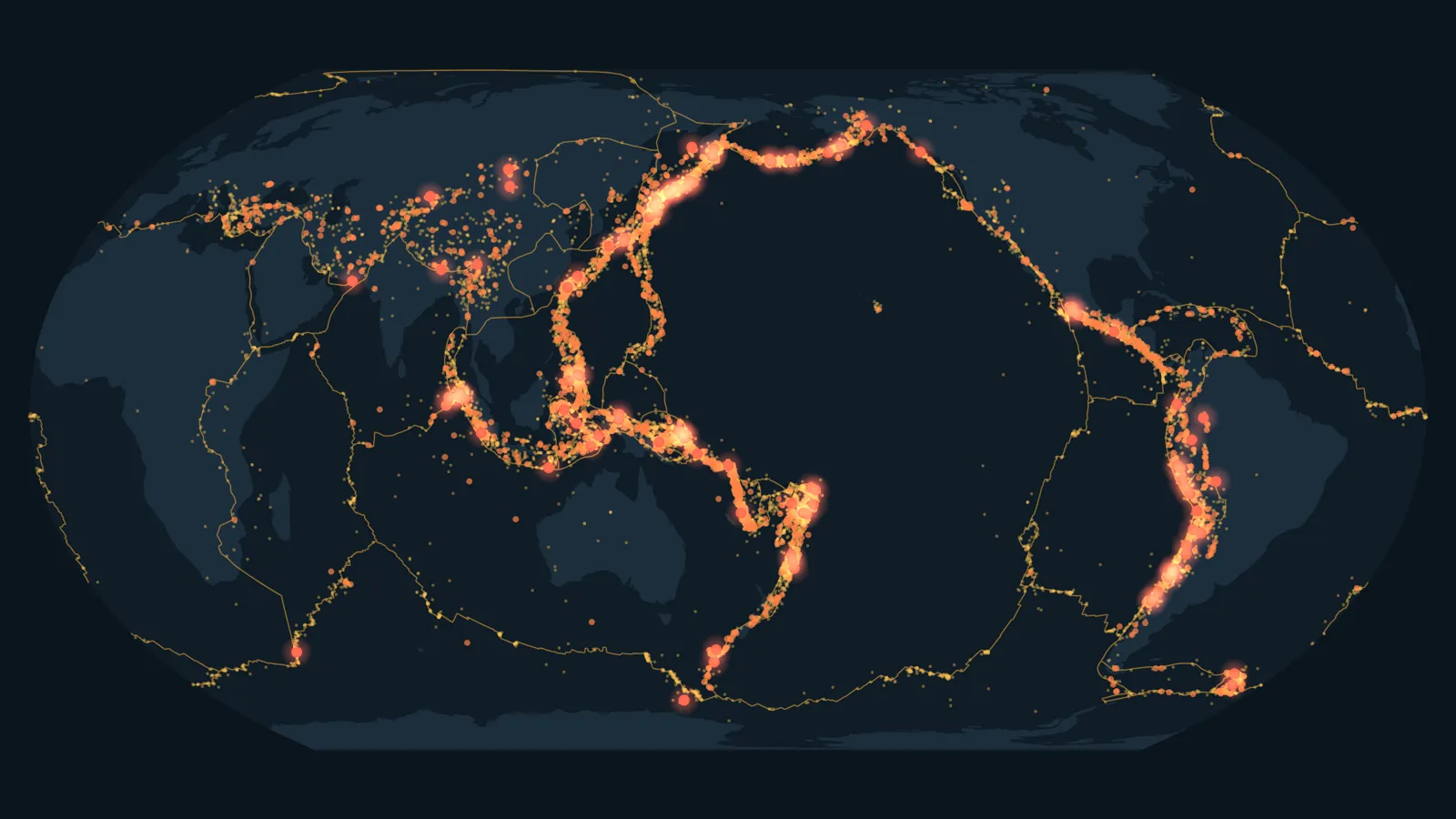
To calculate an earthquake's magnitude, seismologists measure either the waves or the fault. Charles Richter's method takes the height of the biggest wave on a seismogram and the time gap between the P and S waves, then uses ML = log₁₀A + 3 log₁₀(8Δt) − 2.92. The moment magnitude that the USGS uses today multiplies the strength of the rock by the area of fault that slipped and by how far it moved, then takes Mw = ⅔ (log₁₀M₀ − 9.1).
log₁₀(23.0) + 3 × log₁₀(8 × 24.0) − 2.92 = 1.36 + 6.85 − 2.92 = 5.3
About the size of Cairo, Egypt, 1992 (M5.3)
M₀ = 32 GPa × 100 km × 20 km × 2.0 m = 1.3 × 10²⁰ N·m → Mw = 2/3 × (20.11 − 9.1) = 7.3
About the size of Ridgecrest, California, 2019 (M7.1)
Calculating Magnitude From a Seismogram
Charles F. Richter, a seismologist at the California Institute of Technology, introduced earthquake magnitude in 1935. His idea was simple. The bigger the earthquake, the bigger the waves it draws on a seismograph at a given distance. So he measured the largest swing of the pen on a standard instrument, the Wood-Anderson torsion seismograph, and corrected it for how far away the quake was.
The version still taught today, given by Argentina's national seismic institute INPRES, needs only two readings from one seismogram.
- The S−P interval. P waves travel fastest and arrive first. S waves follow. The gap between them, in seconds, grows with distance. Multiply it by about 8 and you get the distance in kilometers, the rule of thumb Saint Louis University uses in its earthquake exercises.
- The amplitude A. The height of the biggest wave on the record, in millimeters.
- The formula. ML = log₁₀A + 3 log₁₀(8Δt) − 2.92. Richter's nomogram, a chart where a ruler joins the two readings, gives roughly the same answer without a calculator.
Take a wave 23 mm high and an S−P gap of 24 seconds. The quake is about 192 km (119 miles) away. The formula gives 1.36 + 6.85 − 2.92, a magnitude of 5.3. One seismograph only gives an estimate, though. INPRES notes that the final magnitude is the average of the values from every station that recorded the quake.
Why the USGS Moved to Moment Magnitude
Richter's original definition held only for California earthquakes, as the USGS points out, and for a single type of instrument. The USGS still uses this local magnitude, ML, but only for stations up to 600 km from the quake.
The bigger problem is size. Scales built on wave height stop growing for the largest earthquakes. The USGS says the body-wave magnitude tends to saturate at about 6.5, and the surface-wave magnitude at about 8.3. On those scales, a magnitude 9 would barely read higher than an 8. Moment magnitude fixes this because it rests on the physical size of the rupture. It was also designed to match the Richter scale where the two overlap, so the numbers feel familiar.
Calculating Moment Magnitude From the Fault
The USGS gives the recipe in two lines. First the seismic moment, M₀ = rigidity × area × slip.
- Rigidity is the strength of the rock along the fault. The USGS uses 32 gigapascals for the crust and 75 for the mantle.
- Area is the part of the fault that slipped, its length times its width.
- Slip is the distance the two sides moved past each other.
Then the magnitude, Mw = ⅔ (log₁₀M₀ − 9.1), with the moment in newton-meters. A fault patch 100 km long and 20 km wide that slips 2 meters gives a moment of 1.3 × 10²⁰ N·m and a magnitude of 7.3.
Play with the calculator and a pattern shows up. Doubling the slip adds only 0.2 to the magnitude. To climb one full step, the moment has to grow about 32 times, which takes a much longer fault, a wider one and more slip at once. That is why the true giants, like Valdivia in 1960 or Tōhoku in 2011, break subduction zones hundreds of kilometers long.
In practice nobody measures the fault with a tape. The USGS works the moment out from the seismic waves themselves, and its authoritative figure, Mww, comes from a long-period part of the wave train called the W phase.
What One Step on the Scale Means
Both formulas use logarithms, so the scale climbs in multiples. According to the USGS, each whole number means waves 10 times taller on a seismogram and about 32 times more energy released. A magnitude 7 is not a little stronger than a 6. It is about 32 times stronger, and about 1,000 times stronger than a 5. Our magnitude glossary has the short version.
Questions About Calculating Magnitude
What Is the Formula for Earthquake Magnitude?
There are two in common use. From a seismogram, Richter's local magnitude is ML = log₁₀A + 3 log₁₀(8Δt) − 2.92, with A in millimeters and Δt in seconds. From the fault, the moment magnitude is Mw = ⅔ (log₁₀M₀ − 9.1), with M₀ = rigidity × area × slip in newton-meters.
Why Does My Answer Differ From the Official Magnitude?
The Richter formula assumes a Wood-Anderson instrument and the rocks of Southern California, and 8 km per second of S−P gap is only an average. Agencies correct for their own instruments and regions, then average many stations. Your result is a good estimate, not the official number.
Is the Richter Scale Still Used?
Yes, for small and nearby earthquakes. The USGS lists local magnitude, ML, for stations within 600 km, and gives moment magnitude as its authoritative value for larger quakes.
See Real Magnitudes Right Now
Our Earthquakes Today page lists every quake on Earth in the last 24 hours with its official magnitude, updated by the minute from the USGS. For the giants of the past, browse the strongest earthquakes since 1900.
Sources
- USGS, Earthquake Magnitude, Energy Release, and Shaking Intensity
- USGS, Magnitude Types
- USGS, Seismogenic zone (shear modulus of crust and mantle)
- INPRES, Instituto Nacional de Prevención Sísmica (Argentina), Cálculo de la magnitud
- Saint Louis University, Earthquake Center, Magnitude 4.1 Earthquake Near Jonesboro Arkansas (locating exercise)
- Live Atlas, reference earthquakes from the event pages (NOAA NCEI and USGS)